
How Ocean Depth Zones Decide What Can Live Below
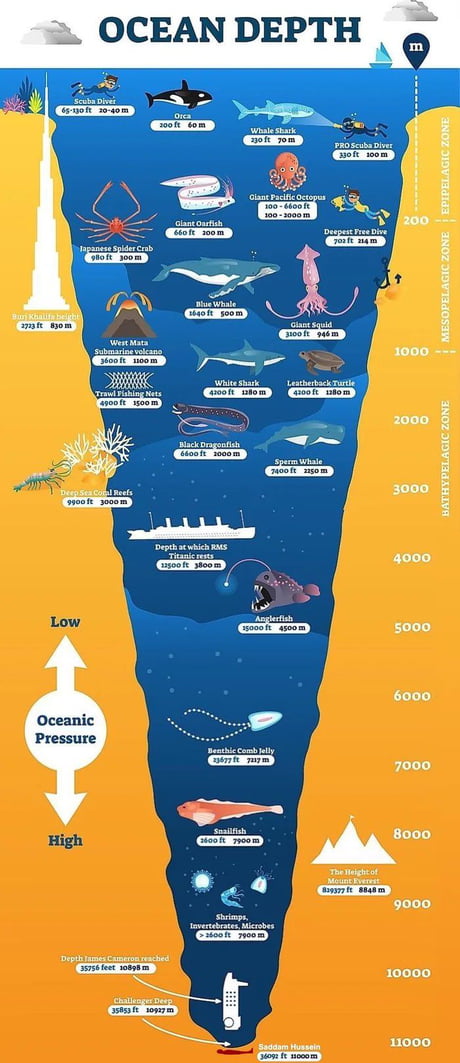
The ocean gets strange fast. Drop below the bright surface where tuna, dolphins, and plankton thrive, and the sea stops behaving like the place most people picture. Light vanishes, pressure climbs with brutal speed, temperatures crash, and life starts looking less like a nature documentary and more like biology under siege.
That’s why ocean depth zones matter. They aren’t just labels on a classroom chart. The epipelagic zone, mesopelagic zone, bathypelagic zone, abyssal zone, and hadal zone map out the hard physical limits that decide which animals can survive, how they feed, and where even our machines begin to fail.
The surface ocean is crowded, bright, and deceptively normal
Oceanographers usually divide the open ocean vertically into five major pelagic layers. At the top sits the epipelagic, or sunlight zone, stretching from the surface to about 200 meters, roughly 660 feet. This is the part of the sea most people know: blue water, photosynthesis, fish schools, whales passing through, and phytoplankton quietly doing the work that props up much of the marine food web.
It’s also where the overwhelming share of ocean life is concentrated. Some estimates put more than 90% of marine life in this upper layer, and about 95% of ocean primary production happens here because sunlight still penetrates the water. That’s the key fact. Life near the top doesn’t just enjoy better visibility; it has access to the basic energy system that powers most ecosystems on Earth.
And that creates a common misconception. People often imagine the deep sea as simply a more intense version of the surface ocean—same rules, just darker. It isn’t. Once photosynthesis drops out, the entire economy of life changes. Food becomes scarce, movement becomes costly, and survival gets tied to falling organic debris, predation, scavenging, or chemical energy from the seafloor.
So yes, the ocean is one connected body of water. But biologically, it’s more like a vertical series of border crossings.
Darkness arrives early, and pressure doesn't negotiate
Below the epipelagic lies the mesopelagic, the twilight zone, from about 200 to 1,000 meters. There’s still faint light here, but not enough for photosynthesis. This is the territory of lanternfish, bristlemouths, siphonophores, and the daily vertical migration of countless creatures that rise toward the surface at night to feed and retreat by day.
Then comes the bathypelagic zone, roughly 1,000 to 4,000 meters—the midnight zone. No sunlight reaches this layer. Temperatures hover near freezing. Pressure keeps mounting at about 1 atmosphere for every 10 meters of depth, which means at 1,000 meters an animal is dealing with around 100 atmospheres. At 4,000 meters, think 400 atmospheres. Human intuition breaks down here because these numbers stop feeling real.
Still, life persists. Anglerfish, gulper eels, giant squid, and a small army of gelatinous predators have made a living in this black water. But they do it with tradeoffs: slower metabolisms, specialized bioluminescence, expandable stomachs, soft tissues, and bodies built to spend as little energy as possible.
Below that sits the abyssopelagic zone, from 4,000 to 6,000 meters. This is where the seafloor plains spread out across huge areas of the planet, cold and starved of food. And below the abyss, in trenches deeper than 6,000 meters, is the hadal zone—the most extreme marine environment on Earth.
Look, this is where a lot of public understanding goes off the rails. People hear “deep ocean” and imagine anything can just keep going lower if it’s tough enough. But pressure is not a motivational speaker. It is a physical force that distorts proteins, membranes, and biological chemistry. Animals don’t beat it through grit. They survive it only through highly specific adaptations.
The hadal zone is not empty—but it does have rules
The deepest trenches are often treated like alien worlds, which is fair up to a point. The Mariana Trench reaches nearly 11,000 meters at its deepest known points. But the hadal zone isn’t empty, and it isn’t lifeless mud either. It contains active ecosystems with scavengers, worms, crustaceans, microbes, and, in some cases, fish.
The record-holder for the deepest-dwelling fish is the Mariana snailfish, Pseudoliparis swirei, observed at depths exceeding 8,000 meters in the Mariana Trench. That matters because fish are vertebrates with the kind of complex tissues and structures pressure tends to punish. The Mariana snailfish gets around that with a gelatinous body, reduced bone density, and high concentrations of trimethylamine N-oxide, or TMAO, a compound that helps stabilize proteins under immense pressure.
Another trench specialist, the hadal snailfish Pseudoliparis amblystomopsis, has been found in the Japan and Kuril–Kamchatka trenches between about 6,500 and 8,000 meters. Its body is soft and transparent, its skeleton more cartilaginous than heavily mineralized, and its skin helps equalize pressure. These are not glamorous adaptations. They are engineering concessions to an environment that punishes rigidity.
And then there are the amphipods—small crustaceans that become monstrous by comparison in the deep. Supergiant amphipods have been documented in the deepest trenches, where they act as scavengers and recyclers of organic matter. Some of them are big enough to unsettle anyone who still thinks the abyss is mostly empty water and a few sad fish.
But here’s the interesting limit: fish appear to hit a depth ceiling at a little over 8,000 meters. Why not deeper? Researchers have long suspected that pressure eventually makes the chemistry too difficult for vertebrate life as we know it. TMAO helps, yes, but only up to a point. Past that, the molecular cost may simply become too high. So when people casually assume fish must be swimming at the very bottom of the Mariana Trench, the data tells a different story.
There is life deeper than the deepest fish. Just not fish life.
Some of the deepest animals don't need sunlight at all
One of the most stubborn myths about the deep ocean is that everything down there lives off scraps falling from above. Many organisms do rely on “marine snow” and sinking carcasses. But not all of them.
In trenches deeper than 9,500 meters in the Kuril-Kamchatka and Aleutian systems, researchers have found tubeworms and mollusks surviving through chemosynthesis-based ecosystems. Instead of depending on sunlight, these communities use methane and hydrogen sulfide from the seafloor. Bacteria convert those chemicals into usable energy, and larger organisms build their lives around that process.
That’s a profound shift. It means the deepest reaches of the ocean are not merely leftovers country. In some places, they run on a different energy source altogether.
Still, let’s not romanticize it. These are harsh, sparse habitats where food is limited, temperatures are low, oxygen can be scarce, and pressure is crushing in a very literal sense. Chemosynthesis opens a door, but it doesn’t turn the hadal zone into a lush underwater paradise. This is, frankly, a bad habit in popular science writing—turning every extreme ecosystem into a hidden Eden. Most of the deep sea is not lush. It is a place where life hangs on because evolution found a narrow loophole.
And that's what makes it impressive.
How deep wrecks, subs, and people actually go
The ocean’s depth zones also help clear up another muddle: how deep our technology can travel versus how deep life can survive. Those aren’t the same contest.
Most shipwrecks people know about are nowhere near trench depth. The Titanic, for example, rests at about 3,800 meters in the North Atlantic—deep, dangerous, and well within the bathypelagic to upper abyssal range, but far above the deepest trenches. Plenty of remotely operated vehicles and crewed submersibles can reach that depth. Very few systems can go much farther.
To reach hadal depths, especially beyond 6,000 meters, vehicles need pressure-resistant housings, specialized materials, and a tolerance for failure that is almost nonexistent. The full-ocean-depth class of submersibles is rare for a reason. Building a machine that can function near 11,000 meters is brutally hard. Building a human-occupied one is harder still.
So what’s deeper: the limits of life or the limits of engineering? For a long time, engineering lagged behind. In some ways it still does. Tiny trench organisms, with their soft bodies and strange chemistry, solved problems that our metal spheres and electronics still struggle with.
There’s a lesson in that. The deepest ocean isn’t inaccessible because we haven’t tried hard enough. It’s inaccessible because the physics are severe, the costs are high, and the margin for error is tiny.
The next decade will bring better trench landers, sharper cameras, more environmental DNA surveys, and probably a few new record-holders from places we’ve barely sampled. But the broad picture is already clear. Ocean depth zones are not arbitrary lines on a chart. They are biological thresholds, and every meter downward strips away another set of possibilities.
That should change how we talk about the sea. Not as one giant blue expanse, but as stacked worlds with hard borders set by light, cold, chemistry, and pressure. The deepest life on Earth isn’t there because the ocean is endlessly forgiving. It’s there because evolution, against the odds, found a way to make almost-unlivable places barely livable.
And if that sounds less comforting than the usual story, good. The deep ocean deserves a little more respect than wonder alone can give it.