
Why Energy Images Mislead the Nuclear vs Renewables Fight
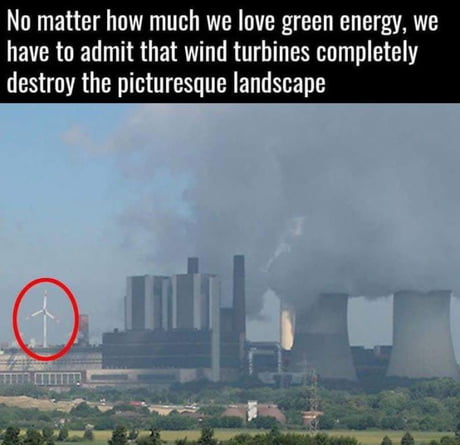
The modern energy argument is fought with pictures first and facts second. A white plume rising from a nuclear cooling tower gets read as pollution. Rows of wind turbines against a sunset get read as moral progress. And once those visual cues lock in, hard data about land use, lifecycle emissions, capacity factors, and waste has to claw its way uphill.
That matters because the nuclear energy debate and the renewable energy debate are now deeply visual. Clean energy, land use, and climate policy are being filtered through aesthetics — what looks dirty, what looks natural, what feels threatening, what seems pure. The result is a public conversation that often mistakes steam for smoke and symbolism for evidence.
Steam looks guilty, even when it isn't
The most famous image in anti-nuclear rhetoric is also one of the most misleading: the cooling tower plume. Those giant hyperboloid towers are dramatic for a reason. They're engineered to be. But what people usually see pouring out of them is water vapor, not combustion exhaust.
That's not a semantic trick. It's the difference between a thermal plant releasing steam after cooling and a fossil plant releasing carbon dioxide, nitrogen oxides, sulfur dioxide, particulates, and other combustion byproducts. A nuclear station can look filthy in a still image precisely because steam photographs so well. Coal pollution, by contrast, can be invisible at the point where the picture is taken.
And that's the trap. The camera rewards spectacle. A cooling tower gives you scale, mood, menace. A transmission corridor or a gas turbine peaker plant often doesn't. So people end up reacting to what reads as contamination rather than what actually is contamination.
You can see this confusion constantly in everyday debate: someone points to “all that smoke,” someone else says it's steam, and the exchange goes nowhere because the visual impression already did the damage. Once a technology has been coded as dirty in the public mind, corrections sound like excuses.
Still, the reverse happens too. Wind turbines and solar arrays are usually photographed under forgiving light — blue skies, green fields, tidy symmetry. They are industrial systems, built from steel, concrete, copper, aluminum, composites, glass, rare and common minerals, roads, substations, and maintenance networks. But they are framed as scenery.
What looks clean isn't always what scales cleanly
That doesn't mean wind and solar are frauds. They aren't. They are real low-carbon tools and both are essential to cutting emissions. But the public case for them is often sold through a kind of aesthetic laundering. A turbine becomes a symbol of harmony with nature even when it's part of a very large industrial footprint. A solar field is described as gentle because the panels don't emit fumes, even though utility-scale solar can transform huge stretches of land.
Look, land use is where the imagery starts to crack.
Nuclear plants produce enormous amounts of electricity from relatively compact sites. Exact numbers vary by design, capacity, and whether you're counting only the fenced plant area or the wider exclusion zone, but the basic point is not controversial: nuclear is one of the most land-efficient low-carbon power sources on the grid. Wind and solar need far more space to produce the same annual output, especially once you account for capacity factor — how often a source actually generates near its rated power.
That is why a single reactor site can be compared with solar projects spread across tens or even hundreds of square kilometers, and wind installations spread wider still. The internet-grade shorthand of “nuclear equals 3 square kilometers, solar 200, wind 900” is too neat to treat as universal fact. Real projects differ. Transmission matters. Storage matters. Local geography matters. But the general direction is right: diffuse energy sources tend to require diffuse footprints.
And that has consequences people don't like to talk about. Habitat fragmentation. Long transmission runs. Visual intrusion across farmland and ridgelines. Industrialization of open space. None of this means renewables should be rejected. It means they shouldn't get a free pass because they photograph well.
This is, frankly, where a lot of lazy argument creeps in. Critics of renewables overstate maintenance horror stories or make cartoonish claims about oil use in turbines as if lubrication wipes out the electricity they generate. It doesn't. Wind turbines do require maintenance, and blades create a real disposal problem because fiberglass-reinforced composites are hard to recycle and can last a very long time in landfill. That's a legitimate materials issue. But pretending the machines are net-energy absurdities is not serious analysis.
On the other side, defenders of renewables sometimes wave away lifecycle costs as if mining, concrete, replacement cycles, and end-of-life waste are beneath discussion. They aren't. If a technology is going to dominate the grid, its full material story counts.
The culture war runs on framing, not physics
Energy fights have become proxy fights about taste and identity. Nuclear gets cast as cold, centralized, technocratic, vaguely sinister. Wind and solar get cast as democratic, local, humane, and morally clean. That framing survives even when the underlying systems don't fit the script.
A large wind project backed by transmission buildout, imported materials, gas balancing, and heavy subsidy can still be described as “natural.” A nuclear plant with tiny direct emissions and decades of dense power output can still be described as “dirty” because the tower plume looks alarming. What are people supposed to trust — a spreadsheet or the giant white cloud in front of them?
That's the real contest.
And it explains why cherry-picked photos are so effective. One image of a cooling tower can imply contamination. One tight shot of a wind turbine can hide the roads, concrete foundations, and scale of the installation around it. One drone frame of a solar field can make land conversion look elegant rather than immense. Visual rhetoric isn't a side issue in energy politics; it is the argument for a lot of people.
But visual framing also drives a false binary. Nuclear versus renewables is often posed as a moral showdown when, in practical grid planning, the stronger case is usually nuclear and renewables versus fossil fuels. Countries trying to decarbonize fast need firm low-carbon generation, flexible resources, stronger transmission, and a lot of new clean electricity. Refusing to admit that because one technology feels prettier is self-indulgent.
Lifecycle impacts are messier than slogans
Every serious energy source comes with tradeoffs. Nuclear has high upfront capital costs, long development timelines in many countries, and a waste problem that is politically explosive even if the physical volumes are small. Wind and solar have lower fuel costs and can be deployed faster, but they are intermittent, infrastructure-hungry, and materially intensive when scaled across a whole grid.
The data on lifecycle emissions is actually less flattering to the culture-war version of this debate than either camp would like. Nuclear, wind, and solar all come in far below coal and gas on lifecycle greenhouse gas emissions. They differ at the margins, but they belong in the same broad low-carbon category. If the public understood that more clearly, a lot of the theatrical outrage would look silly.
Still, lifecycle emissions aren't the only metric. Waste streams matter. Mining matters. Water use matters. Reliability matters. And yes, what happens at the end of a product's life matters too. Wind turbine blades have become a favorite talking point because they expose the gap between “green” branding and industrial reality. Solar panel recycling is improving but remains uneven and economically tricky in many markets. Nuclear waste remains dangerous for long periods, but it is also tightly managed, concentrated, and tiny in volume compared with the diffuse waste streams of the broader energy economy.
The data tells a different story than the pictures do. That's the problem.
Clean energy needs honesty, not better propaganda
If climate policy is going to be driven by public consent, the public deserves a more adult conversation. Not a prettier one. People should know that a cooling tower plume is usually steam. They should know that “renewable” does not mean impact-free. They should know that land efficiency is a real advantage for nuclear, and that speed of deployment is a real advantage for wind and solar. They should also know that no grid built for modern industry runs on vibes.
So, yes, aesthetics matter politically. They always will. People care what gets built near their homes, across their farmland, over their hills, and beside their coastlines. But letting visual instinct stand in for technical judgment is how countries end up with energy systems that are expensive, fragile, or dirtier than advertised.
And that's where this debate is headed next. As grids strain under electrification, AI data centers, heat pumps, and electric vehicles, the easy symbolism will start colliding with hard limits. The winning technologies won't be the ones that look pure in a photograph. They'll be the ones that can deliver massive amounts of clean power without pretending tradeoffs don't exist.